The Fabrics
Batik
Wax. Colour. Pattern.
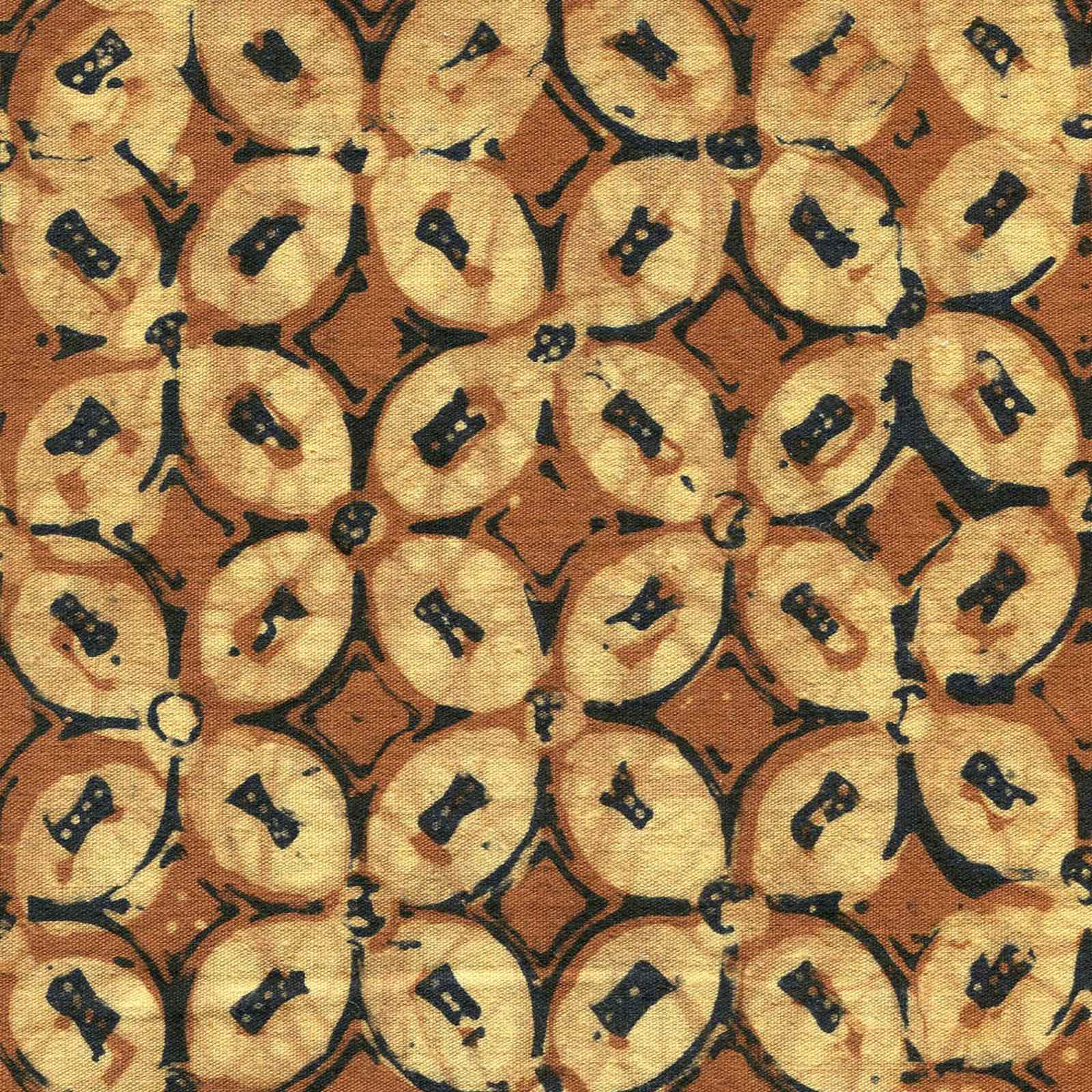
Batik begins with wax, not dye. Pattern is drawn in what refuses colour.
Its story does not begin in Africa — but its second life, on this continent, is very much its own.
The Fabric
Batik is a wax-resist dyeing technique: molten wax is applied to cloth in a pattern, the cloth is dyed, and the waxed areas resist the colour. The wax is later removed, often by boiling, revealing the design beneath — a process that can be repeated in layers to build up multiple colours.
The technique most associated with the name 'batik' originates on the island of Java, in present-day Indonesia, where it developed into a highly refined art form using tools such as the canting, a small wax-filled pen, and the cap, a copper stamp. Javanese batik is recognised by UNESCO as an Intangible Cultural Heritage of Humanity.
A History
Batik's presence in West Africa has a distinct and well-documented history. In the nineteenth century, Dutch traders encountered Javanese batik in the colonial Dutch East Indies and attempted to reproduce it by machine for the Indonesian market. The imitation wax prints did not take hold there in the same way, but found an enthusiastic reception among traders and consumers in West Africa.
From that point, wax-print cloth — manufactured industrially, first mainly in the Netherlands and Britain, later increasingly in West Africa itself — developed into its own major textile tradition, often called Ankara or 'African wax print' today. It is important to note that most of the wax-print cloth worn across West Africa is machine-printed to imitate a resist pattern, distinct from hand-applied batik, which is also practised by artisans on the continent as a slower, studio craft.
In Culture
Wax-print cloth became deeply embedded in West African dress, gifting and commemorative culture — printed for weddings, anniversaries, political campaigns and family celebrations, with individual patterns acquiring local names and meanings far removed from their Javanese origins.
Hand-applied batik, worked directly onto cloth with wax and dye, exists alongside this industrial tradition as a smaller, artisanal practice — closer in spirit and method to its Javanese source, and valued for the individuality that hand work brings to each length of cloth.
The Rini Perspective
Rini works with batik in its hand-applied form — wax drawn and dyed by hand — as a deliberate craft choice, distinct from mass-printed wax fabric. We credit its Javanese origins plainly, while exploring what the technique becomes when guided by an African design sensibility.
For us, batik is a reminder that textile traditions travel. What matters is working with honesty about where a technique comes from, and care in how it is carried forward.
Batik travelled far to find a second home here. Rini works to honour both halves of that journey.